Where robots learn
before they touch hardware.
A high-fidelity physics simulator for reinforcement learning agents. Build complex 3D environments, train policies at scale, and transfer them to real hardware without breaking anything expensive.
Policies trained across randomized dynamics, evaluated against real hardware logs.
Most RL results die in
the last two feet.
A policy scores perfectly in training, then falls over in the lab. The team spends months discovering which unmodelled detail did it. SimRoboX is built around closing that gap rather than hiding it — because the reality gap is not mysterious. It always lives in one of four places.
Dynamics
Friction, damping, torque curves, backlash, mass distribution. Your simulator defaults are not your robot.
Observation
In simulation you read true state. On hardware you read a sensor with noise, drift and dropouts.
Actuation
Commanded torque is not applied torque. There is a delay, a saturation limit and a controller in between.
Timing
Simulation steps deterministically. Hardware has variable loop times and jitter, and policies quietly depend on that.
Built by people who had to deploy the policy afterwards.
SimRoboX is the simulator our own research runs on. Every rough edge we fix is one a researcher hits the next morning — which is a better quality filter than any roadmap.
-
Gym-compatible interface
Existing training code runs against SimRoboX with minimal changes. No rewrite to try it, no rewrite to leave.
-
Domain randomization that is honest
Randomize dynamics, sensor noise, latency and control jitter — at the scale of your actual uncertainty, not an arbitrary ±50%.
-
Multi-agent from the start
Collaborative and adversarial tasks are first-class, not a fork of the single-agent path.
-
Evaluation you can trust
Held-out dynamics, seed variance and trajectory replay against real hardware logs — the tooling that tells you a policy is ready, and the honest version that tells you it is not.
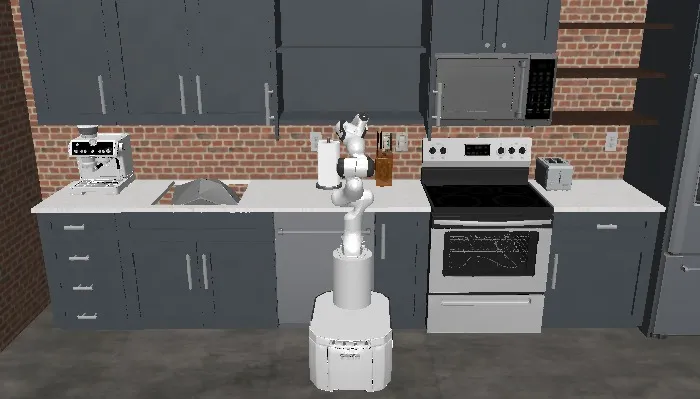
An early SimRoboX environment. The interface is still moving.
Free for academic labs.
We are running private pilots through 2026 with a small number of labs. Waitlist members get access in order, with academic groups prioritised — tell us what you would build with it and we will read it properly.
- Free for academic research and teaching
- URDF import for your own robot
- Direct line to the team building it
- Your feedback shapes the 1.0 interface
Join the waitlist
Tell us about your lab and what you are trying to train.
Questions people actually ask
Still unsure? Ask us directly — a person answers.
When does SimRoboX become available?
We are running private pilots with a small number of academic labs through 2026. Waitlist members get access in the order they joined, with academic labs prioritised.
Will it be free?
It will be free for academic research and teaching. Commercial licensing will be handled case by case.
What simulator does it build on?
SimRoboX layers scene authoring, domain randomization and evaluation tooling over a rigid-body physics backend. The interface is Gym-compatible, so existing training code runs against it with minimal changes.
Can I use my own robot model?
Yes. URDF import is supported, and the environment authoring API is designed around describing your own morphology rather than picking from a fixed catalogue.